
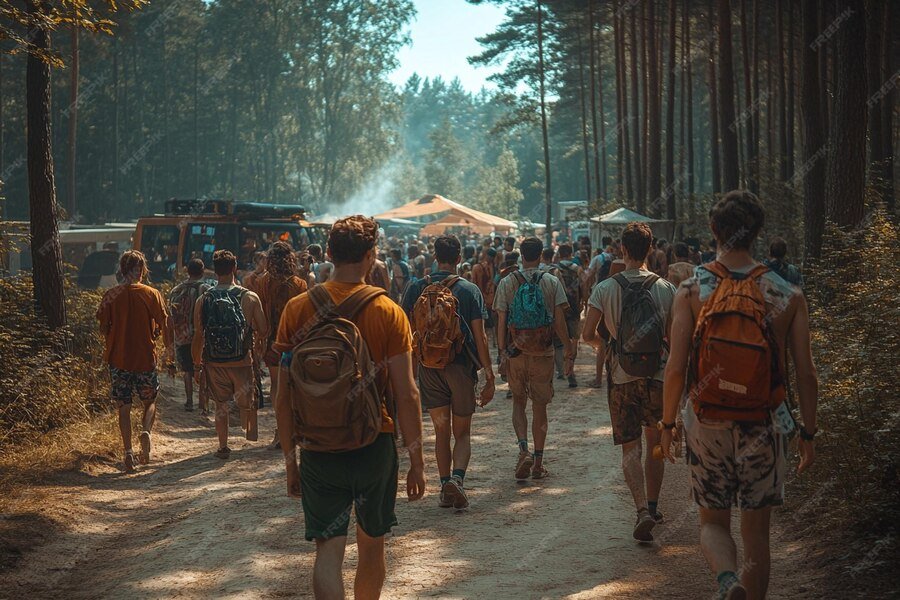
Before Smartphones, Kids Still Found Themselves—Usually in the Woods
There was a time—not so long ago—when children discovered themselves without the help of Google Maps, TikTok trends, or a group chat. Instead, they found themselves surrounded by smoky campfires, sloppy tent preparations, and the triumphant sound of a canoe paddle hitting the water perfectly. If you were lucky, you recall those times. Perhaps it was through the Boy Scouts, Girl Guides, or that odd summer camp that smelled constantly of bug spray and waffles.
These weren’t only summertime activities. They served as crucibles for the character. You discovered that neglecting your rain poncho had consequences. That teamwork was more than just a classroom poster; it was the reason you eventually found your way back to camp. Most importantly, you discovered who you were without the distractions of modern life.
In his passionate work “Wabaningo,” author Jim Valentine conveys this beauty and significance with remarkable clarity. Valentine draws on his own 1950s Boy Scout experiences in Western Michigan to demonstrate that these early outdoor adventures were more than just enjoyable; they were foundational. Let’s look at why these traditions are still relevant today and how they continue to shape who we become. Together, let’s discuss transformative youth journeys – Boy Scouts, backpacking, and becoming.
1. The Heart of the Wilderness: Why These Experiences Mattered
More Than Just Bug Bites and Camp Songs
Camping and scouting were not just just tying knots and earning merit badges. They were about confronting the unknown and recognizing your own capabilities. A dark forest? Spooky, yes. But your ears grew accustomed to the nocturnal sounds, and your confidence increased.
Children learned to rely on themselves and one another. When your group went off track, there was no Uber to come to your rescue. There was just you, your map-reading abilities (maybe), and a friend who remembered the compass.
Resilience through Discomfort
Soggy socks, toasted marshmallows, and snoring bunkmates were not simply minor irritants; they were unplanned lessons that taught patience, adaptability, and courage. In a society that increasingly protects young people from failure, the wilderness provided no such luxury. Did you forget your flashlight? You stumbled. Didn’t you pack enough water? You’ve paid the price. Then you learned. And it got better.
2. Core Values in Action: The Scout Oath as a Life Manual
“On My Honor…”—And We Meant It
If you were ever a member of a scouting organization, you probably recall rising a little taller when saying the Scout Oath. It was not merely a chant. It was a code.
Words like trustworthy, loyal, helpful, and brave were not abstract concepts. They showed up in daily decisions. Do you admit to spilling the water jug? Do you assist the younger scout in tying his crooked bowline knot? Do you volunteer for the dreaded latrine clean-up? (Yes. You did. Because it was your turn.)
What the World Still Needs Today
Let’s face it: these values are more relevant than ever. In the current fast-paced, often self-centered world, the idea of doing your job “to help other people at all times” is both radical and refreshing. In our digitally connected world, we may all benefit from a little more scout-like behavior.
3. Wabaningo Book in Focus: A Story Worth Retelling
A Book That Feels Like a Campfire Conversation
Instead of being a shallow, nostalgic trip, Jim Valentine’s “Wabaningo” is a deep, thoughtful celebration of the meaning of growing up via shared experience and hardship. The novel follows a group of young boys on their summer journey through responsibility, leadership, and self-discovery at a 1950s Boy Scout camp in the forests of Western Michigan.
The accounts are full of vivid imagery, such as paddle strokes cutting through silent water, laughing echoing beneath the trees, and the deep silence of a shared moment under the sky. Every chapter introduces a new challenge, a new option, and a new way for a boy to become more of himself.
Where Storytelling Meets Life Lessons
What distinguishes “Wabaningo” is not simply its authenticity but also its message. Valentine softly reminds us that character isn’t a lecture or a list. It develops minute by moment, often when no one is looking. Whether it’s a canoe race gone wrong or a tug-of-war game turned life lesson, the book emphasizes how these early, earthy events shape who we are.
4. What We’ve Lost—And What We Can Reclaim
The Vanishing Act of Unstructured Time
In today’s over-scheduled, hyper-digital world, many children hardly have the opportunity to be bored, let alone create a fire or follow a trail. Summers are frequently filled with enrichment camps, test prep, and screen time, leaving little time for unfiltered, character-building moments. In order to learn more about how shared adventures teach kids key responsibilities and life’s core values, explore here.
The days of spending hours watching ants carry crumbs or skipping rocks for personal bests are over. But maybe we should bring them back. Maybe growth still exists in those in-between periods that we’ve begun to categorize as “unproductive.”
Reclaiming the Simplicity—and Power—of the Outdoors
You don’t have to enroll your child in Scouts to rekindle the spirit of these adventures. A backyard camping trip, a family hike, or simply allowing your youngster to become (safely) lost in nature can all result in the same transformation. It’s about stepping back so they can take a step forward.
Give them a compass, not a GPS. Let them fail. Allow them to lead. Let them return with muddy shoes and stories to tell.
Closing: A Tribute to Character-Building Traditions and Boy Scouts
Be the Campfire for Someone Else
Character is not something you learn; it is something you catch. Around the campfires. Amid the Boy Scouts Along winding trails. During peaceful stargazing sessions, big questions are asked, and even bigger answers gradually appear. And if you had those moments growing up, maybe it’s time to pass them on. Therefore, with his “Wabaningo Book,” Jim Valentine reminds us of the power of these adventures. His recollections, based on real-life events, not just merely evoke nostalgia; they also highlight the virtues that we risk losing in a fast-paced world. Values such as bravery, honesty, and the calm confidence gained from becoming lost and finding your way back.
So, encourage the next generation to environments where they can become, not merely achieve. Because somewhere out there, someone else is waiting to discover who they truly are—one hike, lesson, and marshmallow at a time. Storytellers like Author Jim Valentine remind us that the muddy, mosquito-bitten moments may be the most important.